Year by year, deep soaking tubs have been rising in popularity. 2015 in particular has seen a surge of new product launches as ever-increasing numbers of designers and manufacturers come to appreciate their benefits. Many modern tubs utilise advanced materials and can be paired with useful features such as hydrotherapy systems and integrated lighting, but the concept of deep soaking is anything but new.
Soaking up to the neck is a centuries-old tradition in Japan, where the ritual of bathing had more to do with introspection and mental relaxation than the day to day business of cleansing. The original wooden soaking tub - the classic ofuro - was a place of calm meditation and users would typically wash themselves before entering it.
The West, of course, observed no such traditions so deep soaking tubs went largely unregarded until the end of the 20th century. Then, in 1991, a Cumbrian product designer named Jeffrey Harrison developed what he called the 'Imersa' - the first ofuro-inspired bath for modern homes. It had a space-saving design but, unlike its Japanese precursors, it was made from a high performance composite that would not rot or warp; a material that could be precisely engineered to accommodate lights, hydrotherapy jets and a variety of other features.
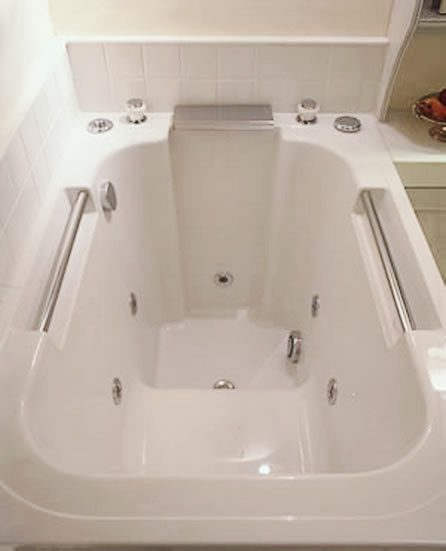
An early Imersa. Note that modern hydrotherapy jets would be smaller and flush-fitting.
Despite its compact footprint, the bath had a far greater depth than anything that European customers had seen before and users quickly recognised that it offered a new kind of bathing experience. With so much of the body supported by the mass of water, it offered a sense of weightlessness and, with the bather adopting a more upright, naturally seated posture, the head, neck and shoulders remained unburdened and much freer to move.
Until this time, most bath tubs had adopted the well known 'horse trough' shape. This was not because this afforded any great user benefits but simply because it was accepted as the norm and because it fitted conveniently into a standard sized bathroom. By contrast the first 'modern deep soaking tub' dispensed with convention and put the emphasis firmly on bathing comfort - thereby starting a change in the industry that has continued to the present day.
With many bathrooms now becoming smaller, space-saving tubs are a common sight in townhouses, boutique hotels and even ordinary homes, and the ability to save water is another important advantage for many. However, for most users, comfort remains the principal reason for the enduring appeal of soaking tubs and their use is by no means confined to bathrooms where space is at a premium. Moreover, the wide variety of materials now available - including metal, wood, stone and composites - means that designers thinking of incorporating one into a scheme are spoiled for choice.
However, soaking tubs were no overnight success and it's interesting to reflect how much contemporary products owe to those early days of development.
Deep soaking tubs - first principles
When creating his first prototypes, Jeffrey Harrison recognised that the defining characteristics of the classic ofuro - square-sided and without a sloping backrest - didn't suit Western preferences. He saw that bathers naturally preferred to sit with their feet lower than the rest of their body, so he refined his designs to incorporate a low, gently reclining seat. These are features now evident in many of the best 21st century soaking tubs - though their origins go back to physical trials first conducted in the early 1990s.
Initially, Harrison's Imersa attracted few imitators. It sold reasonably well and produced enthusiastic reviews but the wider market seemed unsure about the radical new configuration. It was five years before the British manufacturer Design & Form launched an alternative.
Resolving to perfect the deep soaking experience, the company approached another UK specialist, Alan Gorst, whose 1996 design featured armrests, footrests and a curving, sculpted back. The intention was to create a bath that offered a true 'armchair experience'.
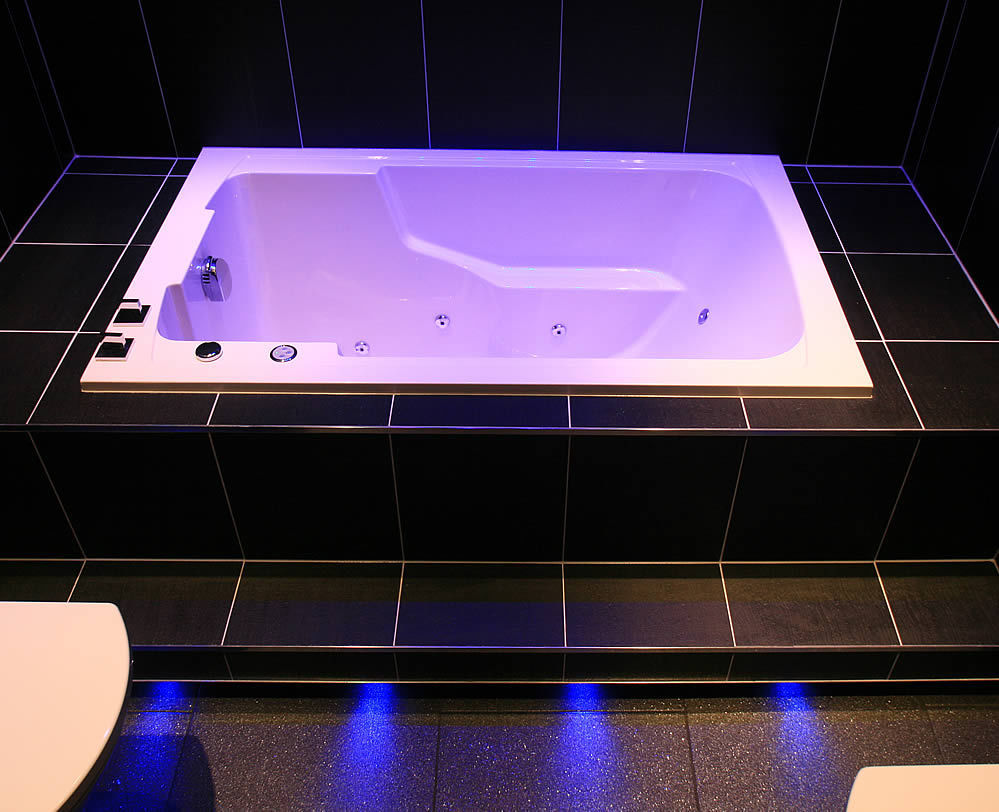
The Nirvana, designed by Alan Gorst. The sloping back and armrests are intended to replicate the experience of sitting in an armchair.
Within a few years, the new model - known as the Nirvana - was selling worldwide, even as far afield as Japan - and, seeing the market maturing, other manufacturers began to produce versions of their own. Some were little more than crude acrylic boxes and were never destined to attract a great following but growing competition was forcing the pace of innovation. Professionals were increasingly specifying soaking tubs for their projects and, accordingly, consumers saw the gradual introduction of other shapes, sizes and materials. Baths in artificial stone and patinated metal offered designers a wider choice of texture and appearance, while wooden models offered the chance to return to the look and feel of the classic ofuro.
Demand and diversification
Since the 1990s, deep soaking baths have developed in a number of different directions as designers have sought to adapt the basic concept to the preferences of modern households. Showering, for example, is part of everyday life so many modern soaking tubs feature enlarged footwells that provide plenty of standing room. Industry feedback would suggest that more than half of all soaking tubs are now used in conjunction with overhead showers and screens. Two-seat models are also now available, as are baths that capitalise on the great natural synergies between deep soaking tubs and hydrotherapy systems.
In terms of style, designers now have considerable choice. Materials such as metal and wood help conjure an impression of tradition, while the use of advanced composites offers improved heat retention and enables the creation of some very striking shapes - be they organic, classic, minimalist or bespoke. What's more, some manufacturers offer an almost limitless range of colours so baths can be produced to match the colours of tiles, fabric, wood and stone.
The future of deep soaking
Where soaking tubs go from here is difficult to predict because as the market grows, so they are likely to continue in their diversification - some becoming larger, some becoming even more space-saving and compact. Some will continue to base their appeal on the use of natural materials while others will emphasise the technical benefits of advanced materials and technologies.
Some, unfortunately, will seek to compete by sacrificing quality for low price and this, perhaps more than anything else, risks jeopardising the sector's image. Just as the touting of low cost whirlpool / spa tubs has undermined the reputation of genuinely effective hydrotherapy systems, so the widespread marketing of cheap plastic soaking tubs could erode faith in a form of bathing that has been slowly improving for nearly 25 years.
Ultimately, style, comfort and function will be the keys to success. An effective soaking tub is a product of good design, diligent research, appropriate materials and quality craftsmanship. It's to be hoped that these features - not an insistence on cost-cutting - come to define such products in the years ahead.
The future, of course, is an unknown but what seems very likely is that baths of this kind will continue to evolve as they enter the mainstream of bathroom design. Rather than comprising a single, easily definable market, deep soaking tubs may well become an umbrella term for a whole host of specialised products.